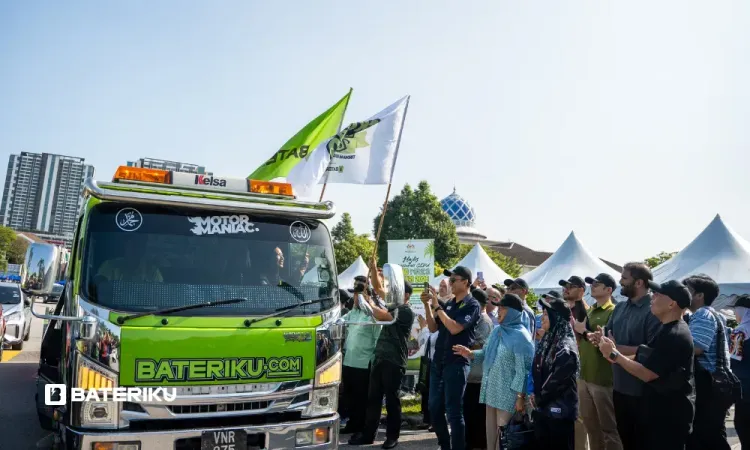
8 February 2026, Bandar Baru Bangi - The Ministry of Natural Resources and Environmental Sustainability (NRES) officially launched the Skuad NRES Lestari Squad, powered by Bateriku, in a ceremony officiated by YBhg. Datuk Ketua Setiausaha. The event was attended by representatives from the Department of Environment (DOE) and various agencies under NRES.
NRES Launches Skuad NRES Lestari Powered by Bateriku
The program aims to increase awareness among the public and civil servants on recycling practices, environmental safety, and long-term sustainability. It supports NRES’s role, together with DOE, as lead agencies in natural resource management and environmental preservation to ensure national sustainability.
Supporting the National Sustainability Agenda
The Skuad NRES Lestari is designed to support key national priorities, including:
- Environmental pollution control and climate change mitigation
- Public wellbeing and sustainable social governance
Through direct community engagement, the program promotes practical actions that contribute to a cleaner and safer environment.
Awareness and Action Through Community Participation
Built on the concept of “awareness and action”, the roadshow features two main components:
- KUDAH Program (Kutip sampah sambil beriadah): picking up litter while exercising
- BSafe Program: education on vehicle, battery, and electric vehicle safety
More than 100 participants joined the program, combining physical activity with environmental stewardship. All collected waste was weighed and recorded as part of environmental impact measurement.
The roadshow begins at Taman Tasik Cempaka, Bandar Baru Bangi, in conjunction with the 2026 Skuad NRES Lestari Opening Ceremony.

Popularising Sustainability at the Grassroots Level
According to Saiful Adib Bin Abdul Munaff, Group CEO of Malaysian Green Tech & Climate Change Corporation (MGTC), the KUDAH program aims to “popularize sustainability” among the public.
He highlighted that global environmental challenges, including climate change, often begin with basic issues such as cleanliness. By participating in simple activities like litter collection, communities can better understand how small actions contribute to broader environmental solutions.
Multi-Stakeholder Participation Strengthens Impact
Public agencies, students, and volunteers unite for a cleaner environment. Volunteers from Indah Water Konsortium, NRES, and students from UKM, UPM, and several polytechnics including Nilai and Port Dickson took part in the activity.
The initiative demonstrated the program’s dual focus on personal health and environmental responsibility, encouraging citizens to stay active while caring for their surroundings.
Preserving Tasik Cempaka for Future Generations
Dato’ Seri Ir. Dr. Zaini Ujang shared that community-based initiatives at Tasik Cempaka began as early as 2016 to raise awareness about the lake’s importance.
While the authorities manage the area, public littering significantly increases maintenance costs. Encouraging families to use the park responsibly and manage their waste helps preserve the lake both as a recreational space and as a flood mitigation system.
Community responsibility reduces long-term maintenance costs.
“Small Actions, Big Impact”
Proper waste disposal supported by strategic partners.
The spirit of the event is captured in the slogan Tindakan Kecil, Impak Besar. The message reminds Malaysians that even simple steps in waste management can create meaningful environmental change.
Partners such as Bateriku play a vital role by providing infrastructure for the proper disposal of specialised waste, including e-waste and used batteries, which many members of the public are unsure how to handle safely.
Educating the Public on Responsible Waste Management
Muhamad Muhtazam Noor Din, President of Kelab Gaya Lestari Malaysia (MGTC), explained that the program also educates participants on sorting different waste types, including e-waste and scheduled waste.
Collected materials are categorised accordingly. Single-use plastic bottles are donated to Masjid Al-Hasanah under the Green House of Worship program, while general waste is weighed and sent to specialised disposal centres to ensure compliance with environmental regulations.
Masjid Al-Hasanah as a Green Community Hub
Malaysia’s first pioneer Green House of Worship. Following the activity, participants gathered at Masjid Al-Hasanah, which serves as the main hub for the Skuad NRES Lestari program.
Recognised as Malaysia’s first Green House of Worship, the mosque has implemented several sustainability initiatives, including:
- A 22.75 kW solar panel system
- Rainwater harvesting for cleaning and irrigation
- Aquaponics projects supporting the asnaf community
- Used cooking oil collection facilities
- A recycling hub that recently collected 60 tonnes of used clothing in one week
Strategic Partnership with Bateriku Expands National Reach
The collaboration with Bateriku includes a RM400,000 contribution to expand the Skuad NRES initiative across Malaysia.
As a leader in battery management, Bateriku collects between 600 and 1,000 tonnes of scrap batteries each month, ensuring proper disposal through licensed channels instead of landfills. The company has also trained over 1,500 technicians through its academy, helping build a sustainable automotive ecosystem and empowering gig workers to become entrepreneurs.
Bateriku as a Sustainability Ecosystem
According to Azarul Faizi, CEO of Bateriku, the company is not just a battery provider but a complete sustainability ecosystem.
Key impacts include:
- Monthly collection of up to 1,000 tonnes of scrap batteries
- Ethical disposal of used lead-acid batteries through DOE-licensed smelters
- Development of 76 local entrepreneurs
- Training more than 1,500 gig technicians nationwide
Branding “Lestari” for Long-Term Behaviour Change
Through this programme, NRES is not merely promoting sustainability as a concept, but nurturing it as a way of life. Our aspiration is for the word ‘Lestari’ to become as familiar in every Malaysian household as the brands we use every day.
“This effort is guided by our 3B framework: Inform, Educate, and Advocate. When people truly understand how waste such as plastics and used batteries pollute our rivers and return to us through the food chain as microplastics, awareness turns into responsibility. From responsibility comes action, and from action, lasting behavioural change.
Sustainability, therefore, is not the duty of the government alone. It is a shared commitment by every Malaysian to protect our environment, our health, and the future of generations to come.” Chief Scretary of NRES, Datuk Dr. Ching Thoo a/l Kim.
Looking Ahead: Policy and Personal Responsibility
The government plans to introduce the Climate Change Act as early as March to address global warming and rising urban flood risks.
While national policies are essential, officials stressed that individual actions also matter. Simple choices such as walking to the mosque, using reusable shopping bags, and choosing five-star energy-rated appliances can significantly reduce carbon emissions.
The program reinforces the idea that protecting the environment is a shared responsibility for all Malaysians.
Strengthening ESG Through Long-Term Collaboration
Implemented using the PDP approach (Preventive, During, and Post), the program is supported by a strategic partnership with Bateriku to empower the Skuad NRES Lestari, which now has over 100,000 members.
Bateriku continues to support the National Green Agenda and the National Energy Transition Roadmap (NETR), focusing on carbon reduction and circular economy development. The company is co-owned by KWAP, MTDC, VentureTech, SBI Venture, and Gobi Partners, reflecting strong institutional confidence in its sustainability role.
Beyond battery services, Bateriku operates as a mobility and sustainability innovation hub, covering ULAB management, e-waste solutions, EV battery diagnostics, MyHIJAU-certified workshops, and human capital development through Bateriku Academy.
Through close cooperation with NRES, Bateriku prioritises Environmental, Social, and Governance (ESG) principles. Together, both parties aim to mobilise communities, industry, and media to strengthen Malaysia’s green agenda and build a healthier, safer, and more sustainable future for the nation.