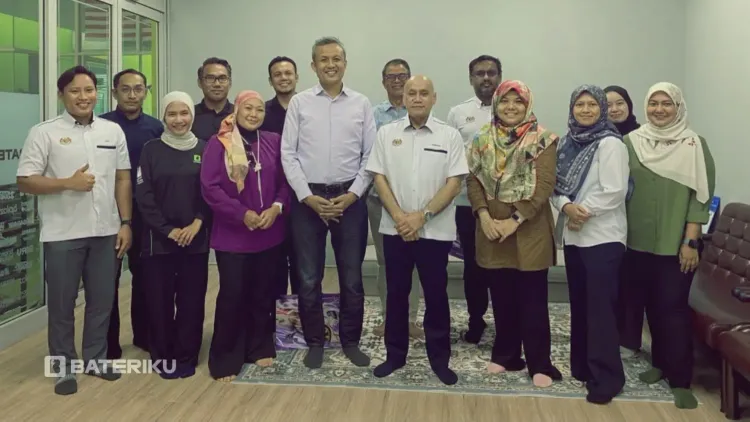
Bateriku could play a broader role in Malaysia's automotive technology ecosystem as the company continues to expand its expertise beyond battery services and roadside assistance.
This potential was discussed during a recent courtesy visit to Bateriku's headquarters by representatives from the Ministry of Science, Technology and Innovation (MOSTI), Malaysia Technology Development Corporation (MTDC), and Malaysian Research Accelerator for Technology and Innovation (MRANTI).
The discussion explored potential opportunities in electric vehicle (EV) technology, battery innovation, digitalisation, sustainability and technology commercialisation, while also looking at how Bateriku's existing capabilities could contribute to Malaysia's ambition of becoming a high-tech nation.

Bateriku Builds a Broader Automotive Ecosystem
Since its establishment, Bateriku has evolved from a battery-focused service provider into a broader automotive ecosystem covering roadside assistance, workshops, technician networks, pick-and-drop services, digital vehicle management and battery recycling.
Its service network is now approaching 300 Pitstops nationwide, supported by thousands of trained technicians, gig workers, automotive partners and business partners.
However, Bateriku's ecosystem extends beyond its physical network.
Strategic partners in Bateriku’s ecosystem
The company currently works with more than 40 strategic partners across telecommunications, gig platforms, financial services, fintech and higher education through API integrations and digital partner systems.
These include established names such as Setel, Touch 'n Go eWallet, Carsome, Maybank, Grab, foodpanda, and FlexiParking, among others.
This cross-industry connectivity gives Bateriku multiple digital touchpoints with both consumers and businesses. Combined with its physical network and trained workforce, these capabilities could provide a platform for Bateriku to explore new technologies and applications across the automotive and mobility sectors.
EV Batteries Identified as a Potential Growth Area
As Malaysia's EV market continues to grow, EV battery technology is emerging as another potential area for Bateriku to develop its capabilities.
As of August 2026, 61,265 EVs had been registered in Malaysia, according to JPJ data, compared with 57,236 EV registrations throughout 2025.
As more EVs enter the Malaysian market, the need for specialised technical expertise will also develop across areas such as maintenance, diagnostics and battery servicing. Building this capability early could position Bateriku to support the growing EV ecosystem as the vehicle population matures.
Opportunities Across the EV Battery Lifecycle
The discussion with MOSTI, MTDC and MRANTI also explored opportunities across the EV battery lifecycle, including research and development, battery development, testing, servicing, recycling and end-of-life management.
One area with potential is second-life battery applications. EV batteries that are no longer suitable for vehicle use may still retain sufficient capacity for other applications, such as stationary energy storage for homes and businesses.
This creates another potential use for EV batteries before they ultimately reach the end of their usable lifecycle.
Makmal Hijau & Briged Hijau are doing their part
Bateriku already has experience in battery lifecycle management through Makmal Hijau and Briged Hijau, which are involved in battery research and recycling activities. These capabilities could potentially serve as a starting point for developing further expertise in handling batteries at scale as Malaysia's EV ecosystem grows.
Bateriku has also been recognised by SVOLT for its capability to perform maintenance on its batteries, providing another foundation for developing specialised EV battery expertise.
Developing capabilities across the battery lifecycle could support both economic and environmental objectives, while aligning with MOSTI's focus on Science, Technology, Innovation and Economy (STIE) and its broader aspiration for sustainable development.
Three Agencies, Complementary Roles
The discussion also highlighted the complementary roles of MOSTI, MTDC and MRANTI in supporting technology development and commercialisation.
MOSTI provides the national direction for science, technology, innovation and the economy, including research and development, technology development and capacity building. MTDC supports Malaysian technology companies as a venture and commercialisation partner, helping technology businesses move towards greater economic sustainability. MRANTI connects innovators with researchers, industry players, funding opportunities and markets to help move research and innovation towards commercialisation.
For Bateriku, this ecosystem could potentially open access to research expertise, universities, technology partners, funding pathways, regulatory stakeholders, talent and new market opportunities. The discussion also emphasised the importance of developing local technology capabilities rather than relying solely on imported technologies, particularly as Malaysia seeks to strengthen its expertise in emerging fields such as EVs, batteries and automotive technology.
From Malaysia to ASEAN
The company has already begun expanding into Indonesia, with broader ambitions across the ASEAN region. This creates potential opportunities to bring Malaysian-developed products, services and technological capabilities to regional markets.
With a network approaching 300 Pitstops nationwide, thousands of trained technicians, and more than 40 digital and ecosystem partners, Bateriku has established several of the building blocks needed to support this expansion.
The engagement with MOSTI, MTDC and MRANTI could therefore mark another step in exploring how Bateriku's existing automotive ecosystem can evolve further, particularly in EV technology, battery lifecycle management, digital automotive services and technology commercialisation.