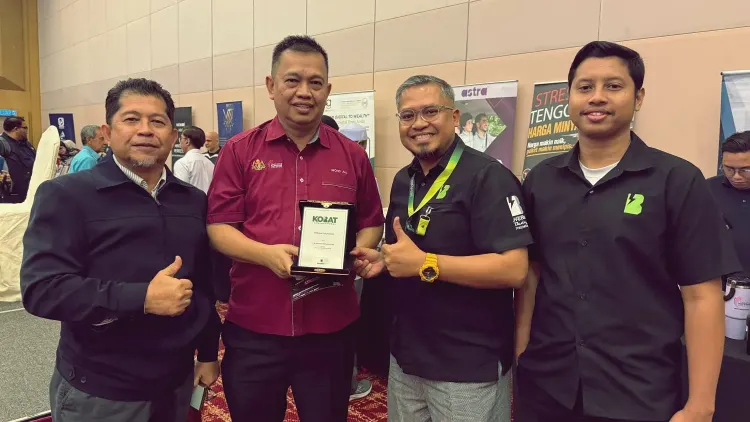
1 July 2026, Bangi - Koperasi Bateriku (KOBAT) participated in the rogram Biacara CEO: “Strategi Pemulihan - Membina Kota, Mengukuh Takhta,” organised by the Institut Koperasi Malaysia (IKMA). Held at Hotel Tenera, Bangi, the programme gathered cooperative leaders from across Malaysia to hear insights from two professional speakers, each representing different but complementary fields.
KOBAT’s presence at the programme was not merely for exposure. It was an opportunity to engage more closely with industry players and exchange perspectives on the current challenges faced by cooperatives, such as maintaining healthy profit margins, strengthening member loyalty, and navigating the pressure of modernisation.
Below are key takeaways gathered by KOBAT that are also relevant for other cooperatives.

Building the “City” with En. Bujang Hussin
En. Bujang Hussin, CEO of Menagemix Sdn. Bhd. and a certified Dale Carnegie trainer, opened his session with a simple but powerful question: which cooperatives are confident they will still be operating in five years’ time? The silence that followed from participants clearly reflected a deeper concern that many cooperatives are not fully prepared for upcoming challenges.
From this, he introduced the KOTA framework, a practical checklist to help cooperatives operate with clarity, speed, and direction:
- Leadership (Kepimpinan) – Board members must have strong vision and commercial understanding, not just be appointed based on popularity. He stressed that leadership without execution capability often becomes a key reason for organisational decline.
- Operations (Operasi) – Reduce bureaucracy and diversify income sources. He shared examples of cooperatives that recovered from crises by pivoting from transport into hospitality, or from agriculture into eco-tourism as a secondary revenue stream.
- Digital Transformation (Transformasi) – Member databases, digital financial reporting, and modern payment methods (QR codes and e-wallets) are no longer optional. They enable faster decision-making by removing reliance on manual reporting processes.
- Active Members (Ahli) – Loyalty cannot be assumed simply because someone is a member. Cooperatives need two-way communication and continuous feedback to ensure members remain engaged and the organisation stays relevant.
He concluded with a traffic-light recovery model: red (30 days of structured diagnosis), yellow (pilot initiatives before scaling), and green (full-scale execution once validated).
Dr. Mohd Afzanizam Abdul Rashid: Understanding the Macro Perspective
Dr. Mohd Afzanizam Abdul Rashid, Chief Economist at Bank Muamalat Malaysia, shifted the discussion from internal management to external forces shaping the economy.
Key topics included geopolitical tensions in the Strait of Hormuz, which have disrupted tanker routes and contributed to global inflation. Since Malaysia relies partly on energy imports through this route, any disruption places upward pressure on the local economy, even with government subsidies in place.
He also highlighted the importance of monitoring regional developments. For instance, while countries like Indonesia have adjusted interest rates more aggressively, Malaysia has maintained a more stable monetary policy under Bank Negara Malaysia.
One notable observation was the growing role of government cash transfers (such as STR and SARA) in household income. This raises concerns about whether wage growth from employment is keeping pace with living costs.
From an economic output perspective, only about one-third of value generated is reflected in wages, while the remainder flows to capital income such as profits, dividends, rent, and other returns. This suggests that while the economy is growing, the benefits are not evenly reaching workers.
He also pointed to the oversupply of unsold housing below RM500,000 as a signal of widening income inequality, an area where cooperatives may have an opportunity to play a stronger role. He further suggested that structural tax reforms such as a potential return of GST could be part of future policy direction, and cooperatives should prepare early for such changes.
What KOBAT Learned
Although the two speakers approached the topic from different angles, their message was aligned. Cooperative sustainability is not abstract but it depends on clear, deliberate action.
En. Bujang emphasised that small, structured, and fast-moving internal improvements can lead to meaningful recovery. Meanwhile, Dr. Afzanizam stressed the importance of looking beyond internal operations and incorporating macroeconomic realities into strategic planning.
Together, both perspectives reinforce a single idea: cooperatives that stay adaptive, data-driven, and closely connected to member needs are better positioned to remain resilient in a changing environment.