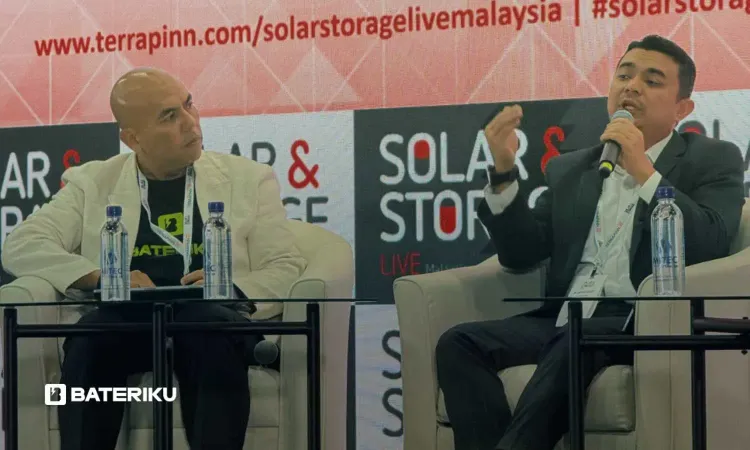
Bateriku took centre stage at Solar & Storage Live Malaysia 2026, playing a leading role in shaping conversations around the future of electric vehicle (EV) transportation in the country. Chief Business Officer (CBO) Syed Faiz moderated a panel discussion focused on EV infrastructure readiness, current policy frameworks, and national grid capacity.
The panel, titled "Managing the EV Load: Policy, Tariffs, and Smart Charging Regulations in Malaysia", featured IR. Mohd Razif bin Abdul Halim, President of the Malaysia Zero Emission Vehicle Association (MyZEVA), and Bruce Sui Chung Yik, Head of Industry Relations at ChargehereEV Solution Sdn. Bhd. (ChargeSini).

The conversation centered on three interconnected challenges shaping Malaysia's EV landscape: energy supply and management, charging infrastructure, and regulatory oversight.
Malaysia's National Grid Can Handle EV Demand
Malaysia's electricity supply system has advanced considerably over the past two decades. The country's total electricity supply capacity grew from 104,000 GWh in 2006 to over 211,000 GWh in 2024, a near doubling that reflects steady industrial growth and economic expansion.
On the demand side, EVs currently account for a negligible share of national electricity consumption. In 2022, the transportation sector used just 0.26% of Malaysia's total electricity whicha figure dwarfed by the industrial and commercial sectors.
The panel agreed that while EV adoption is growing, its impact on overall energy demand remains minimal. Based on current growth trajectories, EVs are projected to consume less than 5% of total grid capacity by 2030. The real concern, then, is not whether the national grid can cope but it's whether the local infrastructure serving individual neighbourhoods and buildings can keep up.
The Real Barriers to EV Ownership in Malaysia
Despite the room for growth, several structural challenges continue to slow EV adoption. These are not insurmountable, but they require deliberate policy and infrastructure investment to address.
1. Ageing Local Infrastructure Strains Charging Installation
At the macro level, Malaysia's grid is well-positioned to absorb EV demand. At the micro level, however, localised electricity networks are already under pressure. Dense urban areas particularly older residential zones, rely on outdated distribution infrastructure, including ageing transformers and copper cabling that were not designed to handle concentrated spikes in electricity demand.
Add high-rise residential developments into the mix, and the strain becomes even more acute. Malaysia's EV challenge, in this sense, is less about the availability of electricity and more about its reliable delivery to where it's needed most.
2. High-Rise Living Remains the Biggest Obstacle
The single greatest barrier to broader EV adoption may be the growing number of Malaysians living in high-rise residences such as apartments, flats, and condominiums. Unlike landed homeowners who can install home chargers with relative ease, high-rise residents face a unique set of hurdles:
- Limited building electrical capacity
- Mandatory approval from the Joint Management Body (JMB)
- Complex utility billing arrangements
- Additional fire risk compliance requirements
The panel stressed that resolving these high-rise charging challenges is a critical near-term priority, especially given that high-rise dwellers make up an increasingly large share of the Klang Valley's population. Without accessible home charging, a significant segment of potential EV buyers will remain on the sidelines.
3. Fragmented Regulatory Approvals Slow Public Charging Deployment
Beyond infrastructure, the regulatory landscape poses its own challenges. Installing a single public EV charger in Malaysia currently requires navigating between three and seven different agencies, depending on the charger type and location.
At a minimum, operators must engage:
- Suruhanjaya Tenaga (ST) — for charging equipment licensing
- Local Authorities (PBT) — for permits and construction plan approvals
- Tenaga Nasional Berhad (TNB) — for electricity supply arrangements
Depending on the site, additional approvals may be needed from:
- JBPM (Fire and Rescue Department) — for fire risk assessments on commercial DC charger installations
- Lembaga Lebuhraya Malaysia (LLM) / Ministry of Works — for installations along highways or at R&R stops
- Jabatan Tanah & Galian — for temporary land use permits (TOL)
- Joint Management Body (JMB) — for strata-titled residential properties
This multi-agency maze discourages charging operators from aggressively expanding DC public charging networks. AC chargers, while subject to simpler regulatory requirements, offer slim profit margins that make large-scale investment difficult to justify.
To help navigate these realities, the panel highlighted two practical solutions: installing AC chargers for personal home use, and adopting Time-of-Use (TOU) tariffs to both reduce the cost of EV ownership for consumers and ease pressure on the national grid during peak hours.
The panel also touched on Vehicle-to-Grid (V2G) technology. Acknowledging that while it remains in early stages for Malaysia, it holds genuine long-term potential. As grid demands evolve, V2G could serve as both a relief valve for the national network and an indirect cost-saving mechanism for EV owners.
Price Is Just One Piece of the Puzzle
The panel discussion made clear that Malaysia's EV transition hinges on more than just vehicle pricing, though affordability undeniably remains a key consideration for most buyers.
The more nuanced reality is that many Malaysians who can afford an EV are still holding back. Questions about charging access, lifestyle adjustments, and long-term ownership costs are shaping purchasing decisions just as much as the sticker price. Addressing these concerns requires a holistic approach, one that spans infrastructure, regulation, and consumer education.
Bateriku's Role in Malaysia's EV Ecosystem
Bateriku's participation as moderator at Solar & Storage Live Malaysia 2026 reflects the organisation's deepening commitment to the green energy and electric mobility sectors. By facilitating dialogue between industry players, policymakers, and other stakeholders, Bateriku is actively contributing to the healthy development of Malaysia's EV landscape.
Organisations interested in collaborating on green technology initiatives are welcome to reach out to Bateriku.