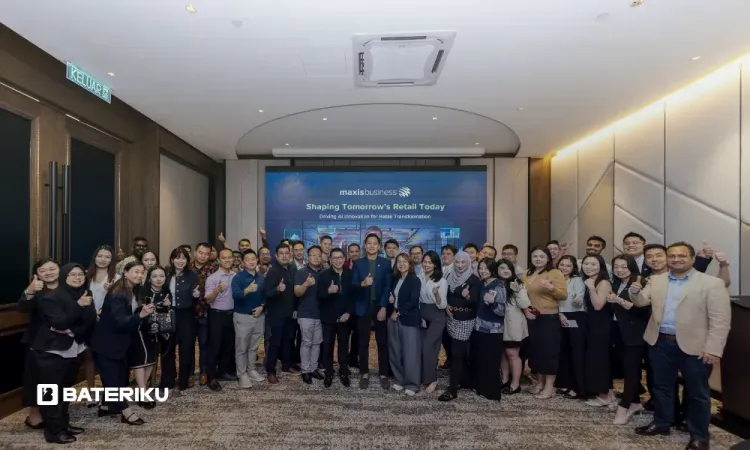
20 November 2025, Kuala Lumpur – Maxis Business hosted a focused session on Driving AI Innovation for Retail Transformation at M Resort Hotel Kuala Lumpur. The event gathered industry leaders, analysts, and technology practitioners to examine how AI is reshaping retail operations and customer engagement.
Maxis Business Spotlights AI Innovation for Retail, Bateriku Shares Its Path Forward
Bateriku Digital was invited to join the session as a growing player in Malaysia’s digital ecosystem. The event aligned strongly with the latest International Data Corporation (IDC) findings commissioned by Maxis, which highlighted where Malaysian enterprises stand, where they fall behind, and what businesses must prioritize to stay competitive in a fast-changing retail and services environment.
Key Insights From Maxis and IDC
Malaysia is at a critical point in its digital evolution. Despite the clear need for transformation, the nation is still playing catch-up regionally.
- Only 63 percent of Malaysian enterprises have moved beyond the nascent stage of digital transformation, trailing Southeast Asia’s average of 73 percent.
- Only 47 percent have reached a developing level, well behind SEA’s 54 percent.
- Malaysia’s projected IT spending growth of 5.7 percent in 2025 lags far behind global momentum.
- Years of treating IT as a support function rather than a strategic priority have created investment gaps in modern digital infrastructure.
- A major concern: 76 percent of Malaysian digital projects fail to deliver expected outcomes due to weak digital leadership, legacy systems, underdeveloped data capabilities, and talent shortages.

Where Malaysia Focuses vs Leading Digital Enterprises
IDC highlighted a clear contrast in priorities.
Malaysia typically emphasizes:
- Improved employee productivity
- Faster innovation
- Cost savings
- Business resilience
- Agility
- Faster time to market
These are operational and tactical. Meanwhile, leading digital enterprises prioritize:
- Revenue growth
- Higher profits
- Customer satisfaction
- Operational efficiency
- Reduced business risk
- Sustainability
The gap reveals that Malaysia still focuses on internal improvements instead of strategic outcomes related to growth and customer impact.
Four Pillars of a Digital Business Framework
Businesses that are aiming for long-term competitiveness should align with these four pillars:
- Digital Business Models
Reimagine products and services with a clean customer-centric approach. - Organization
Prepare the workforce for AI-augmented roles and future ways of working. - Data
Treat data as a strategic product and build a strong data-driven culture. - Operational Processes
Improve responsiveness by connecting assets, people, and partners through digital systems.
IDC also outlined four practices shared by successful AI adopters:
- Apply a unified governance framework.
- Standardize AI architecture.
- Train employees for human-AI collaboration.
- Treat data as a product.
The State of AI Adoption in APAC
Malaysia and the region are entering a period of rapid AI acceleration.
“AI spending will grow at 1.6 times the rate of overall digital technology spending over the next three years, generating over USD 1.2 trillion in APAC economic impact by 2027.”
Retail & Services Sector: Challenges and Priorities
The Retail & Services sector, which includes roadside assistance and on-demand services like Bateriku, is navigating several urgent challenges:
- Labor shortages and rising wage expectations
- Increasing demand for digital experiences
- Higher operating costs
- Pressure to adopt omnichannel strategies and personalized engagement
To stay competitive, retailers and service providers are prioritizing:
- Omnichannel experiences
- Personalized engagement
- Operational automation
- Better inventory and asset turnaround
- Data-driven customer targeting
Technology Gaps That Must Be Addressed
The IDC study identified urgent areas where Retail & Services organizations need investment:
Technology Area = % Organizations Needing Investment
- Automation to improve operations - 55%
- IoT & Mobility - 50%
- Data Management & Analytics - 45%
- Digital Innovation Tools - 40%
- Back-office Applications - 40%
- GenAI & AI - 30%
For Bateriku, the high need for Automation (55 percent) and IoT & Mobility (50 percent) directly aligns with the company’s operational model, which depends on fleet coordination, real-time data, and quick service response.
AI Adoption Priorities and Barriers
Half of Retail & Services organizations are already implementing AI across multiple projects. Their goals are clear:
- Cost savings
- Revenue growth
- Increased profits
However, adoption is slowed by:
- Limited third-party data
- Security concerns
- Lack of AI knowledge
To move forward, IDC recommends broadening AI strategies beyond productivity tools and building foundational capabilities in IoT, cloud infrastructure, security, and data analytics.
Retail Transformation Insights From Industry Leaders
The event also included perspectives from across the retail ecosystem.
AEON’s Digital Journey
Low Ngai Yuen, Managing Director of AEON 360, shared how AEON is rethinking its operating model to stay ahead of consumer expectations.
Accelerating Retail With AI and Data
Wong Chee Voon, Head of Cloud Solutions at Maxis, explained how AI can shorten sales cycles and support business expansion.
Visual Analytics in Daily Operations
Marvin Liong, Head of IoT Practice, showed how visual analytics helps retailers optimize store performance.
The Road Ahead for Digital and AI Innovation in Malaysia
For Bateriku, the session confirmed that the company is moving in the right direction. Our in-house software development team continues to drive growth and help the business scale faster.
Building RSA.my as a SaaS Platform
Bateriku will introduce RSA.my as a SaaS solution for roadside assistance, expanding its technology capabilities to wider markets.
Advancing AI With FATIN
Our Fully Autonomous Text Interaction (FATIN) is being deployed progressively. Upcoming versions will include voice recognition, multilingual capabilities, and smarter customer interaction management.
Malaysia must shift from basic digital improvements to bold, customer-focused strategies that drive revenue, lift satisfaction, and improve long-term competitiveness. For companies like Bateriku, this means investing in automation, IoT, data mastery, and AI-driven processes while preparing the workforce for the next stage of digital maturity.
With the right leadership focus and the right foundational technologies, Bateriku is well-positioned to shape tomorrow’s service and retail landscape through smarter tools, better data, and AI-powered customer experiences.